
Summary
- False doors were symbolic gateways between the living and the underworld.
- Originated in the Old Kingdom, became prominent in the 4th-6th dynasties, evolving artistically.
- Carved from limestone or wood, resembling real doors with painted designs to resemble granite.
- Acted as a link between the living and the afterlife, facilitating communication with the deceased.
- Inscriptions depicted the deceased’s name, titles, and standardized offering formulas.
- Various examples found worldwide, showcasing ancient Egyptian beliefs and history.
- False doors were intricately designed, featured representations of daily life, and were oriented towards the west.
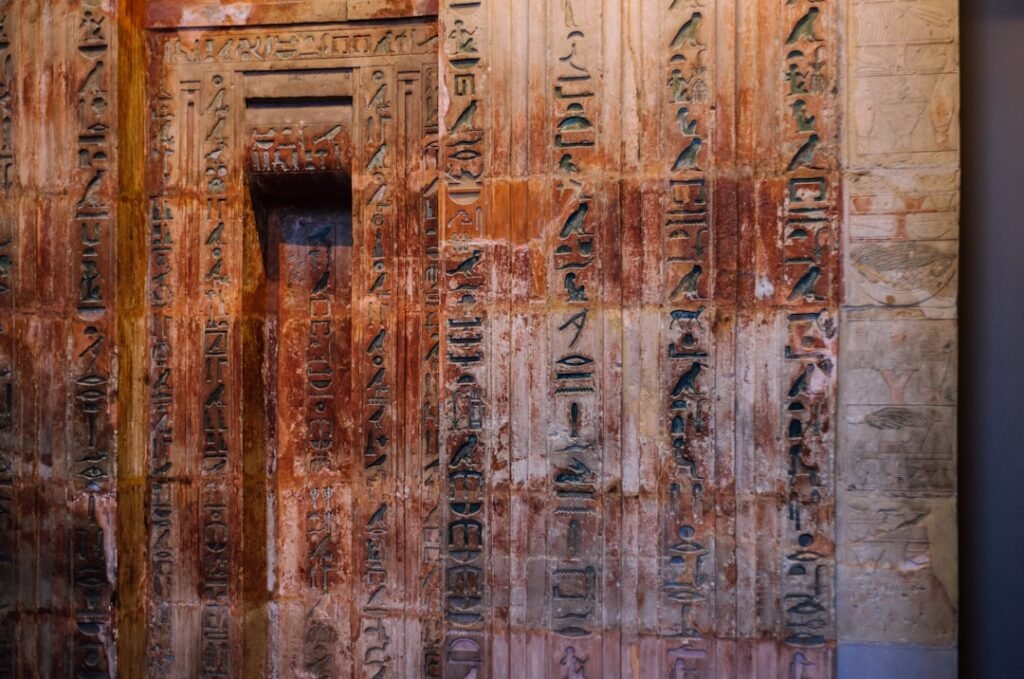
Within the back of mortuary temples and tombs of ancient Egypt lies the false doors, which acted as a gateway to the underworld. The false doors were believed to be a link of communication between the worlds of the living and the dead, by which the spirit of the deceased could enter and exit from the underworld.
The family members of the deceased believed the door could be used to interact with the dead as the family of the deceased placed offerings in front of the door, so it was uncommon to find false doors located on the sides of ancient Egyptian coffins.
The History of the False Doors In Ancient Egypt
The false doors were developed countless times throughout history and it was used first in the external motif of the mastabas of the tombs of the high officials during the third dynasty of the old kingdom in ancient Egypt, as shown on the outer wall of Djoser Saqqara pyramid complex that date to the early dynastic period (3100 – 2156 BC), as seen on the niched palace façade motif. The use of the false doors was first noticed in the 3rd dynasty of the Old Kingdom (2700 BC –2200 BC) as seen across Sean Khui Ptah in the Teti cemetery at Saqqara, then became common and universal in the 4th through the 6th dynasties and even the style of the decoration would seem to change as images of the deceased emerged from the false door.
During the reign of Pharaohs Merenre, Pepi I, and Pepi II of the 6th dynasty, the false doors contained several changes in their artistic style across the panel’s layout, which was a key factor in dating a number of different temples and tombs. The false door between 2181 BC and 2055 BC diminished in popularity and then was replaced by a stela, which transformed into the main surface for carving many funerary inscriptions, but many false doors were able to make their way to the middle kingdom of ancient Egypt (2040 BC – 1782 BC) as seen in the Coffin of Nakhtkhnum which dates all the way to the late Dynasty (1850–1750 BCE).
During the new kingdom of Egypt (1570-1050 BC), the false door was associated with a chapel known as “The Hearing Ear” which was located in the outer wall near the back of the temple close to the sanctuary as it was believed that it would act as a direct manner of communication with the gods. After the end of the new kingdom, the popularity of the false doors diminished and was replaced by stelae; later on, the false doors became highly popular in the interiors of both houses and tombs of ancient Rome.
The Structure of the False Doors
The false door was carved from a single block of limestone or wood. They would paint the doors with black speckles to resemble granite, and in the center of the door is a flat panel with several pairs of door jambs arranged around in order to give the illusion of depth, frames, and a passageway and carved directly above the central panel of the door is a semi-cylindrical drum.
The doors also hold many inscriptions and texts showcasing the virtues of the deceased and expressing positive wishes for the afterlife plus a series of offering formulas that were believed to allow the deceased to partake in offerings presented to the major deities in the name of the king, or in offerings presented directly to the deceased by family members. It also included a cruise for those who would harm the deceased and a blessing to anyone who would make an offering. The representations of false doors in ancient Egyptian tombs often took the form of the “Hotep” hieroglyph, portraying a loaf on a mat. The offering formula was inscribed on the deceased. These false doors featured offering tables made of stone, adorned with various depictions and decorations illustrating offerings such as beer, bread, fowl, and ox.
Depressions were intentionally crafted on these tables to receive symbolic gifts. Tomb owners went a step further by carving statues resembling themselves, placing them within the central niche of the false door. The intricate combination of hieroglyphs, offerings, and personalized statues reflected the profound cultural and religious significance attached to the afterlife in ancient Egyptian burial practices.
Origins of False Doors
The art of ancient Egyptian architecture was incredibly inspired by Mesopotamian precedents, which adopted the civic architecture and the main elements of the Mesopotamian temple. Around the fourth millennium BC, this swapping of arts and ideas was part of Egypt/ Mesopotamia relations and was very effective. The marvelous Recessed niches, which were considered one of the main characteristics of Mesopotamian temple architecture, were later adopted in the inner workings of Egyptian architecture and played a role in the Mastaba tomb’s designs at the times of the 1st and 2nd dynasties in the Naqada III period (3000 BCE). It is believed that the design was transferred due to the traders and workmen of Mesopotamia in Egypt and through the designs that appeared on imported seals of Mesopotamian roots, which have behaved as a main source of Egyptian architects’ inspiration.
The origin of the false door may even extend outside the boundaries of Egypt, which comes in the shape of epic painted doors across Julius Polybius Roman Villa found in Pompeii. The false doors have been seen on the gate of the ancient Egyptian gods found in the Peru region in the Hayu Marca Mountain. It was seen in the tomb of the Augurs near Tarquinia, Lazio, Italy, which dates to around 530-520 BC, and the Tomb of the Charontes at Tarquinia in Italy. In The Hellenistic cemetery at the Al-Abd archaeological site in Alexandria, which was discovered in 2018, a false door was discovered, which is highlighted by foreign civilizations and cultures.
Purpose of the False Doors In Ancient Egypt
The False Door’s purpose was seen as a threshold between the afterlife and the realm of the dead where the spirits lived. The gods and goddesses of ancient Egypt used the false door to interact with the world of the living by delivering messages, crossing over, and receiving offerings. The false door was considered a critical architectural piece found on all the tombs and mortuary temples throughout the Old Kingdom (2700 – 2200 BC) to the New Kingdom (1570 – 1050 BC). It was considered to be the door of ka. This imaginary artistic door is a magnificent recessed niche filled with meaningful inscriptions and images where the family of the deceased can communicate with their loved ones.
It explains why it earned the title of “The Hearing Ear” where each person had his false door, and offerings were presented on a special slab found in front of the door. The false doors acted as a main element in the tomb complex found on the western wall of the offering room of the chapel because the ancient Egyptians believed that the realm of the dead lived in the far west. The false doors can show the interaction between the dead and the living creatures, plus all the physical requirements that bonded the spiritual entities with each other, creating a bridge that connected everyone with the power of texts and funerary practices.
Inscriptions of the False Doors In Ancient Egypt
The side panels of the false doors are known to be covered by several inscriptions showcasing the deceased’s name and titles, which held many standardized offering formulas. These texts radiate some virtues and good deeds of the deceased and provide good positive wishes for the deceased in the afterlife. In the earliest mastabas, the formula invoked the god Anubis, such as “Htp di nswt inpw nb tA Dsr” translating to “An offering that the king gives, and Anubis Lord of sacred land“. The name of God Osiris was introduced to the formula in the late 4th Dynasty or the beginning of the 5th, as seen in “Htp di nswt wsir nb Ddw” meaning “An offering that the king gives and Osiris Lord of Djedu“.
Since the Old Kingdom, the offering formula has been a constant presence on the false door’s lower lintel. During the Middle Kingdom, it began to appear more frequently on door jambs and panels. The formula “Htp di nswt” might be considered an abbreviation for the broader formula for food offerings, with “Htp di inpw” constituting a separate formula invoking Anubis for the deceased’s well-being in the afterlife. various epithets of other gods were incorporated into offering formulas, as illustrated by “Htp di nswt ptH-skr wsir nb anx HkA Dt xnsw Hry ib wAst” denoting “A gift which the King gives, before Ptah-Sokar, Osiris, and Khonsu Lord of Thebes“.
Examples of the Writings on the False Doors
For example, the false door of Ankhires reads:
The scribe of the house of the god’s documents, the stolist of Anubis, follower of the great one, follower of Tjentet, Ankhires.
The lintel reads:
His eldest son it was, the lector priest Medunefer, who made this for him.
The left and right outer jambs read:
An offering which the king and which Anubis,
who dwells in the divine tent-shrine, give for burial in the west,
having grown old most perfectly.
His eldest son it was, the lector priest Medunefer,
who acted on his behalf when he was buried in the necropolis.
The scribe of the house of the god’s documents, Ankhires.
Some of the inscriptions also contain a curse that has the power to harm the deceased and provide bliss and fortune to everyone who made an honest offering. Located on the tomb of Redi-ness in Giza, which states the following texts: “Never did (I) do any evil thing against people. (As for) those who will do something against this, it shall be protected from them”.. (I) have constructed this my (tomb) with my own means. It is the god who will judge (my) case along with him who does anything against it”.